Wednesday, May 11, 2011

Players Championship - An Early Battle


PONTE VEDRA BEACH, Fla. – Miserable drive pushed left. Even more miserable, it hit a tree and bounced straight down in rough. Most miserable of all, he had a nasty lie and a whopping 251 yards to the front of the green at the par 5 16th.


Hey, it was a practice round, right? Pick it up and toss it in the fairway, right?


Wrong.


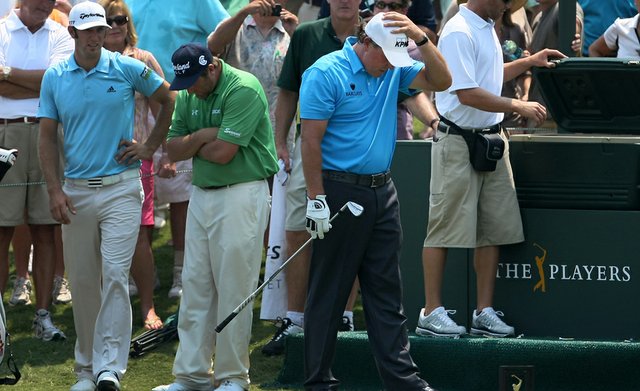
It was a practice day, but this was no practice round. It was Tuesday, but it may as well have been Sunday with the Players Championship on the line. So Phil Mickelson settled over his shot and took a mighty swipe, trying his best to chase something down the fairway and toward the green.


And just what was consuming Mickelson’s attention on a quiet Tuesday at the Stadium Course? The fact that he and Jeff Overton were locked in a fierce match against Dustin Johnson and Steve Marino, that’s what. It was a rematch of a battle waged at Whistling Straits during last summer’s PGA Championship; Mickelson and Overton won that one, but if they were going to repeat, they were going to have to scramble because things were not good here at the 16th.


Oh, did we mention that a few dollars were at stake? Nothing that would match this week’s purse, mind you, but surely this was not a $5 Nassau.


“Guys just don’t do this anymore,” said Butch Harmon, walking along to keep tabs on two of his guys, Mickelson and Johnson. “But this is good. You get to work on what you’re going to face in competition.”


Having been 2 up when Overton birdied the par 5 11th, Mickelson’s team was now in full hang-on mode. Marino had birdied the 12th to get one hole back and now here at the 16th, Johnson was the only one to reach the green in two. That pretty much put the pressure squarely on Overton, for after carving a second shot out of that nasty lie, Mickelson left his third shot short of the green and wasn’t in position to make birdie.


From a greenside pot bunker, Overton hit a terrific shot to 8 feet. But with Johnson already in for birdie, Overton could not convert, so the match was all square.


“It keeps everything fun, makes you grind and hit some golf shots,” Johnson said.


The tall and lanky one from Myrtle Beach did just that at the 17th, his wedge to the island green coming to rest some 20 feet behind the hole. Marino then went long and into the water. Mickelson followed with a similar shot, much to his dismay. And that left things on Overton’s shoulders, which is why on a quiet Tuesday practice round he backed off his tee shot not once, but twice, before also finding the putting surface.


Clutch stuff, eh?


“Hey, we don’t play a lot of team golf,” Overton said, “so it’s fun to do this, to get together and talk some smack.”


Chances are, you couldn’t have found this sort of action anywhere else at the Stadium Course. That’s because the business attitude has blanketed the tour, so many players following a ritual and a blueprint that calls for workout regimens, practice range time, couch work with the shrink, and appointments with the short-game coach, the putting coach, the full swing coach, the hybrid coach.


“But what these guys are doing,” Harmon said, “is what guys used to do all the time.”


Only thing is, with outrageous sums of money available, players don’t need the cash games like they once did, which is why guys such as Mickelson, Overton, Johnson, and Marino gravitate to one another. With Mark Calcavecchia on the Champions Tour, John Huston rarely in action, Paul Azinger somewhere riding his motorcycle, and John Daly more about selling merchandise out of his motor home than reviving his game, there are fewer and fewer candidates around to have matches like what Mickelson & Co. had at Whistling Straits at last summer’s PGA Champship. On that day, Overton matched Johnson’s birdie at the 17th to keep the match even and Mickelson birdied 18 to win.


The rematch was scheduled for Augusta, only rain washed it out. So it was agreed by all that early Tuesday of Players Championship week they’d gather at the first tee to continue the fun.


Fun, of course, being a relative term when competitive juices are flowing. At the par 5 11th hole, for instance, Overton missed the green to the left with his second shot and discovered casual water. He marked, inspected his options for so long, that Marino finally walked over.


“What’s going on? I’ve got to check on you,” Marino said.


At the par 3 13th, Mickelson was short of the green and pitched to 4 feet, then marked his ball. Conferring with Overton over a sliding 12 foot putt, Mickelson saw it moving to the left, his partner agreed, then rolled it. But he played far too much break and when it did move left, it took a slope, and rode hard down into a bowl some 40 feet away.


“Not quite that much,” Mickelson said, shaking his head.


No such problems at the 17th, because Overton cooly two-putted the island green to match Johnson, sending the competition to the 18th hole.


If you’re thinking the scenario was gift-wrapped for Mickelson, you’re right. He drove through the fairway and came to rest beneath a small tree. But after Johnson went long and Overton was short with easier shots, Mickelson did what Mickelson does best – created some magic. He hit a hard, low shot that hit short of the green and almost on cue from his urging it to “hop up there,” the ball did just that, then rolled right of the hole, turned left, and came to rest 12 feet away.


Johnson missed his birdie try, Overton covered that par, and no matter that it was just a practice round, Mickelson had the stage to himself.


And made the putt?


“Of course,” Johnson said, shaking his head.


So, it was sort of a repeat of Whistling Straits, eh, with Mickelson making birdie at the final hole to win?


“Let’s not talk about that,” Marino said.


But on a sultry practice day with so little going on, it was the only stuff worth talking about.

Saturday, May 7, 2011

Golf Legend Ballesteros Dies

FILE - In this May 18, 2007 file photo, Seve Ballesteros smiles before teeing off on the first hole during the Regions Charity Classic golf tournament at the Robert Trent Jones Golf Course in Hoover, Ala.
MADRID -- Seve Ballesteros, a five-time major champion whose passion and gift for imaginative shot-making invigorated European golf and the Ryder Cup, has died from complications of a cancerous brain tumor. He was 54.
A statement on Ballesteros' website early Saturday said the golf great died peacefully at 2:10 a.m. local time, surrounded by his family at his home in Pedrena, in northern Spain.
Ballesteros, a two-time Masters champion and three-time winner of the British Open, was as inspirational in Europe as Arnold Palmer was in America, a handsome figure who feared no shot and often played from where no golfer had ever been.
Headlines such as "The Inventor of Spanish golf" and "Life of a Legend" were splashed across Spanish media websites as fellow golfers, athletes and figures from around the world paid tribute.
George O'Grady, the chief executive of the European Tour, said Ballesteros was the inspiration behind the tour.
"This is such a very sad day for all who love golf," O'Grady said on the tour website.
"Seve's unique legacy must be the inspiration he has given to so many to watch, support, and play golf, and finally to fight a cruel illness with equal flair, passion, and fierce determination. We have all been so blessed to live in his era. He was the inspiration behind the European Tour."
Spanish golf federation president Gonzaga Escauriaza said Ballesteros, an "icon" of Spanish golf, transformed the sport.
"Severiano Ballesteros was a unique, unrepeatable person," Escauriaza said. "We have to recognize we are where we are now, that golf is a popular sport ... in large part to Severiano Ballesteros. We all owe him a lot."
No. 1-ranked Lee Westwood wrote on Twitter: "It's a sad day. Lost an inspiration, genius, roll model, hero and friend. Seve made European golf what it is today. RIP Seve."
In a long list of spectacular shots, perhaps the most memorable came from a parking lot next to the 16th fairway at Royal Lytham & St. Annes in the 1979 British Open. Leading by two shots in the final round, he drove his ball into the lot, had a car removed to get his free drop, then fired his second shot to 15 feet and made birdie on his way to his first major.
"He was a man who got into trouble. Only for Seve, there was no such thing as trouble," Gary Player once said. "He could manufacture shots like a genius."
His last challenge came from an unbeatable foe -- cancer.
Ballesteros fainted in a Madrid airport while waiting to board a flight to Germany on Oct. 6, 2008, and was subsequently diagnosed with the brain tumor. He underwent four separate operations, including a 6 1/2-hour procedure to remove the tumor and reduce swelling around the brain. After leaving the hospital, his treatment continued with chemotherapy.
Ballesteros looked thin and pale while making several public appearances in 2009 after being given what he referred to as the "mulligan of my life." He rarely was seen in public since March 2010, when he fell off a golf cart and hit his head on the ground.
His few appearances or public statements were usually in connection with his Seve Ballesteros Foundation to fight cancer. He wanted but was unable to take part in a champions exhibition at St. Andrews in the British Open.
Such was his stature, even out of the public eye, that European players celebrated his most recent birthday -- the Saturday of the Masters -- as if it was a national holiday.
For such greatness, his career was relatively short because of back injuries.
Ballesteros won a record 50 times on the European tour, his first as a 19-year-old in the Dutch Open, his last when he was 38 at the 1995 Peugeot Open in his native Spain. That also was his last year playing in the Ryder Cup, where he had a 20-12-5 record in eight appearances. He was captain in 1997 when Europe won at Valderrama.
"He did for European golf what Tiger Woods did for worldwide golf. The European Tour would not be where it is today if not for Seve Ballesteros," Nick Price, whose brother died from the same problem last year, said from a Champions Tour event in Alabama. "His allegiance to the European Tour was admirable. The guy, he was an icon, just an incredible golfer."
Ballesteros was the reason the Ryder Cup was expanded in 1979 to include continental Europe, and it finally beat the United States in 1985 to begin more than two decades of dominance. While others have played in more matches and won more points, no player better represents the spirit and desire of Europe than Ballesteros.
Mark Calcavecchia, winner of the British Open in 1989, was awed by some of the shots Ballesteros produced.
"The best imagination. The best short game. You never really knew where he was going to hit it," he said.
"I think I played him twice in the Ryder Cup. I'm pretty sure I never beat him in a match. He was certainly awesome, and really very charismatic."
Ballesteros announced his retirement in a tearful press conference at Carnoustie before the 2007 British Open. Ballesteros had returned to Augusta National that year to play the Masters one last time, but shot 86-80 to finish last. After turning 50, he tried one Champions Tour event, but again came in last.
His back was ailing, his eyes were no longer as lively, and his best game had left him years earlier.
"I don't have the desire," said Ballesteros, who remained active in golf after he stopped playing regularly, mainly through golf course design.
His desire was as big a part of his game as any shot he manufactured from the trees, the sand -- just about anywhere.
Born April 9, 1957 in the tiny town of Pedrena, Spain, he learned golf with only one club -- a 3-iron -- that forced him to create shots most players could never imagine.
Ballesteros first gained major notoriety at 19 in the final round of the British Open at Royal Birkdale, where he threaded a shot through the bunkers and onto the green at the 18th hole, finishing second to Johnny Miller and in a tie with Jack Nicklaus.
"He invented shots around the green," Nicklaus said in the weeks before Ballesteros was inducted into the World Golf Hall of Fame in 1999. "You don't find many big hitters like him with that kind of imagination and touch around the green. He's been a big inspiration to golf in continental Europe, more than anyone has."
Ballesteros went on to win the Order of Merit on the European tour that year, the first of six such titles. Two years later, he won the first time he teed it up in America, a one-shot victory at the Greater Greensboro Open.
Partly because of his humble roots, partly because of his Spanish blood, Ballesteros always played as though he had something to prove. Even after some called him "Car Park Champion" for his shot at Lytham when he won the 1979 British Open, the Spaniard showed that was no fluke when he arrived at Augusta National the next year.
He obliterated the field in the 1980 Masters, much like Tiger Woods did in 1997. Applying his genius to a course built for imagination, Ballesteros took a seven-shot lead into the final round and led by 10 at one point until he started spraying tee shots and won by four. Even so, at 23 he was the youngest Masters champion until Woods won at age 21.
Ballesteros won the Masters again in 1983, and he was equally dominant in golf's oldest championship. He won the British Open in 1984 at St. Andrews over Tom Watson, then won again at Lytham in 1988 by closing with a 65 -- the best score of the tournament -- to beat Price and Nick Faldo.
His career was marked by nasty disputes with European tour officials and PGA Tour officials. He quit the European tour in 1981 in a disagreement over appearance money, the only year he missed the Ryder Cup. He became angry with PGA Tour commissioner Deane Beman in 1985 for not playing the required 15 events for membership.
Despite his five majors and 87 titles around the world, Ballesteros forever will be linked to the Ryder Cup. He developed an "us against them" attitude that became infectious with what had been an inferior European team. He made his teammates believe.
Ballesteros was headed for defeat in 1983 at PGA National, his ball beneath the lip of a bunker, some 245 yards from the green, when he lashed a 3-wood to the fringe and escape with a halve against Fuzzy Zoeller. The Americans narrowly won, but the Ryder Cup was never the same after that year -- and perhaps after that shot.
"His desire to beat the Americans was paramount, and probably the reason they beat us," Watson said. "The Ryder Cup became the focus of world golf, and Seve was right there as the leader."
He teamed with Jose Maria Olazabal to become the most formidable partnership in Ryder Cup history, producing an 11-2-2 record. In his final Ryder Cup, at Oak Hill in 1995, he was playing a singles match against Tom Lehman when Ballesteros drove wildly to the right.
A TV commentator said his only two choices were to pitch back to the fairway or play a big hook around a massive tree. Ballesteros studied his options, then hit over the green to the front of the green.
Such was the unpredictable nature of Ballesteros. There have not been many like him, if any at all.
"Seve is a genius, one of the few geniuses in the game," Ben Crenshaw once said. "The thing is, Seve is never in trouble. He's in the trees quite a lot, but that's not trouble for him. That's normal."
On Friday at the Spanish Open, Jose Maria Olazabal and Miguel Angel Jimenez -- good friends of Ballesteros' -- were in tears as they came off the El Prat golf course upon learning of Ballesteros' deteriorating state. Olazabal and Ballesteros combined to form one of the greatest Ryder Cup pairs in history.
"What he did in sport is unbelievable," top-ranked tennis player Rafael Nadal said on Friday. "These are tough moments."
Ballesteros and his wife Carmen divorced in 2004. They had three children together.

Tuesday, April 12, 2011

Observations of 3 Masters Champions

As I sit here, I have no idea where to begin about this year’s Masters… that hasn’t already been said on every media source on the planet.

This was SUCH an interesting Masters and not just for probably the most exciting final round that I can remember…but also the multitude of side stories that went on.

From the Japanese players discipline and concentration while thousands lie dead at home, to the return of Amy Mickelson back to the Masters after her unfortunate illness. Freddy Couples great play in the first two days, only to be brought down by that nagging back.

Even the TV ratings made the news, while this year’s audience was down 13% from last years, I am sure it was not due to the play on Sunday, but more due to the huge audience that tuned in last year to see Tigers return to the links after his self imposed exile after single handedly  destroying one of the most famous marriages in the world.

Maybe that’s where I will go with this….. the differences we saw between the new young sensations vs. the old young sensation.

Tiger, Charl & Rory

Despite Rory’s excellent play over three days and nine holes, his challenge, like so many other young players (since Tiger?) was denied….the grand course of golf beat Rory into submission, and what Augusta didn’t do, Rory did to himself… a classic melt down.

Tiger, especially on Sunday’s front nine showed life….but he also displayed the behavior that turned me off for years, the same behavior he swore he would never do again…. In his “determination” to be a better golfer, a better role model, a better person…etc.

We saw none of it.

Again he was not only disconnected with the gallery, he was icy cold, and removed from his fan base…. He has proven that he is still so self centered, he does not feel the need to repay, let alone acknowledge, those who supported him for years in buying into his endorsements, or those who cheered him on during the low time of his career.

Even in defeat, he refused to tip his hat (something he stated a person should ALWAYS do), he never complemented any players, instead he made excuses why he didn’t win.

On the flipside, Rory McIlroy granted and gave a great interview with Kostas…even though he looked drained and defeated in every aspect, he was gracious articulate and made no excuses…he even Tweeted a bit later: “Well THAT didn’t go to plan”…then went on to say “You have to lose before you can win” and “This day will make me stronger”.

Words of true class and a true champion… not the Champion of this Major…but he will win his share over the years to come, and it couldn’t happen to a better person.

I just saw another tweet from Rory this morning….as he was getting on the plane for next week’s Malaysian open, he found himself on the same plane with Charl Schwartzel  and asked the new Masters Champ to have his picture taken with him! Then shared the photo to the world.

The Tweeted Image of Charl and Rory
Again, a class act, that typifies the fresh, mature attitude of a future Majors champion….something diametrically opposite of what the previous champion would have done.

If this is the direction professional golf is going, then I am all for throwing out the old and bringing in the new.

Friday, April 8, 2011

BREAKING NEWS! Common Sense Hits the PGA!!!!

Who woulda thunk it???? I stated this should have been done many times and drew, lets just say, negative responses by Rules gurus who believe that "rules are rules" and should never be questioned.


Whereas our thought process is as the times and technology changes the scope of the game, so should the rules, in order to assure fairness for all. (see below announcement).


R&A, USGA revise decision on DQ for incorrect scorecard


FAR HILLS, N.J. -- The R&A and the USGA have announced a new interpretation of the rules that apply in limited circumstances not previously contemplated by the Rules of Golf where disqualifications have been caused by scorecard errors identified as the result of recent advances in video technologies.
This revision to Decision 33-7/4.5 addresses the situation where a player is not aware he has breached a Rule because of facts that he did not know and could not reasonably have discovered prior to returning his scorecard. Under this revised decision and at the discretion of the Committee, the player still receives the penalty associated with the breach of the underlying Rule, but is not disqualified.
In revising the decision, The R&A and the USGA confirm that the disqualification penalty still applies for scorecard breaches that arise from ignorance of the Rules of Golf. As such, this decision reinforces that it is still the responsibility of the player to know the Rules, while recognizing that there may be some rare situations where it is reasonable that a player is unaware of the factual circumstances of a breach.
This revision to Decision 33-7/4.5 is effective immediately.
"For some time we have been concerned that, in certain limited circumstances, disproportionate disqualification penalties have been required by the Rules," said Peter Dawson, chief executive of The R&A. "This carefully considered decision reflects our desire to ensure that the Rules of Golf remain fair and relevant in the changing environment in which the game is played today."
"This is a logical and important step in our re-evaluation of the impact of high-definition video on the game," said Mike Davis, executive director of the USGA. "We collectively believe that this revised decision addresses many video-related issues never contemplated by the Rules of Golf."
The complete language of the revised decision follows.
33-7/4.5 Competitor Unaware of Penalty Returns Wrong Score; Whether Waiving or Modifying Disqualification Penalty Justified
Q. A competitor returns his score card. It later transpires that the score for one hole is lower than actually taken due to his failure to include a penalty stroke(s) which he did not know he had incurred. The error is discovered before the competition has closed.
Would the Committee be justified, under Rule 33-7, in waiving or modifying the penalty of disqualification prescribed in Rule 6-6d?
A. Generally, the disqualification prescribed by Rule 6-6d must not be waived or modified.
However, if the Committee is satisfied that the competitor could not reasonably have known or discovered the facts resulting in his breach of the Rules, it would be justified under Rule 33-7 in waiving the disqualification penalty prescribed by Rule 6-6d. The penalty stroke(s) associated with the breach would, however, be applied to the hole where the breach occurred.
For example, in the following scenarios, the Committee would be justified in waiving the disqualification penalty:
A player makes a short chip from the greenside rough. At the time, he and his fellow-competitors have no reason to suspect that the player has double-hit his ball in breach of Rule 14-4. After the competitor has signed and returned his score card, a close-up, super-slow-motion video replay reveals that the competitor struck his ball twice during the course of the stroke. In these circumstances, it would be appropriate for the Committee to waive the disqualification penalty and apply the one-stroke penalty under Rule 14-4 to the player's score at the hole in question.
After a competitor has signed and returned his score card, it becomes known, through the use of a high-definition video replay, that the player unknowingly touched a few grains of sand with his club at the top of his backswing on a wall of the bunker. The touching of the sand was so light that, at the time, it was reasonable for the player to have been unaware that he had breached Rule 13-4. It would be appropriate for the Committee to waive the disqualification penalty and apply the two-stroke penalty to the player's score at the hole in question.
A competitor moves his ball on the putting green with his finger in the act of removing his ball-marker. The competitor sees the ball move slightly forward but is certain that it has returned to the original spot, and he plays the ball as it lies. After the competitor signs and returns his score card, video footage is brought to the attention of the Committee that reveals that the ball did not precisely return to its original spot. When questioned by the Committee, the competitor cites the fact that the position of the logo on the ball appeared to be in exactly the same position as it was when he replaced the ball and this was the reason for him believing that the ball returned to the original spot. As it was reasonable in these circumstances for the player to have no doubt that the ball had returned to the original spot, and because the player could not himself have reasonably discovered otherwise prior to signing and returning his score card, it would be appropriate for the Committee to waive the disqualification penalty. The two-stroke penalty under Rule 20-3a for playing from a wrong place would, however, be applied to the player's score at the hole in question.
A Committee would not be justified under Rule 33-7 in waiving or modifying the disqualification penalty prescribed in Rule 6-6d if the player's failure to include the penalty stroke(s) was a result of either ignorance of the Rules or of facts that the player could have reasonably discovered prior to signing and returning his score card.
For example, in the following scenarios, the Committee would not be justified in waiving or modifying the disqualification penalty:
As a player's ball is in motion, he moves several loose impediments in the area in which the ball will likely come to rest. Unaware that this action is a breach of Rule 23-1, the player fails to include the two-stroke penalty in his score for the hole. As the player was aware of the facts that resulted in his breaching the Rules, he should be disqualified under Rule 6-6d for failing to include the two-stroke penalty under Rule 23-1.
A player's ball lies in a water hazard. In making his backswing for the stroke, the player is aware that his club touched a branch in the hazard. Not realizing at the time that the branch was detached, the player did not include the two-stroke penalty for a breach of Rule 13-4 in his score for the hole. As the player could have reasonably determined the status of the branch prior to signing and returning his score card, the player should be disqualified under Rule 6-6d for failing to include the two-stroke penalty under Rule 13-4. (Revised)